

 Contact us
Climate Change: Initiatives Aimed at Carbon Neutrality
- Home > Sustainability > Environment >
Measures for Achieving Carbon Neutrality by 2050
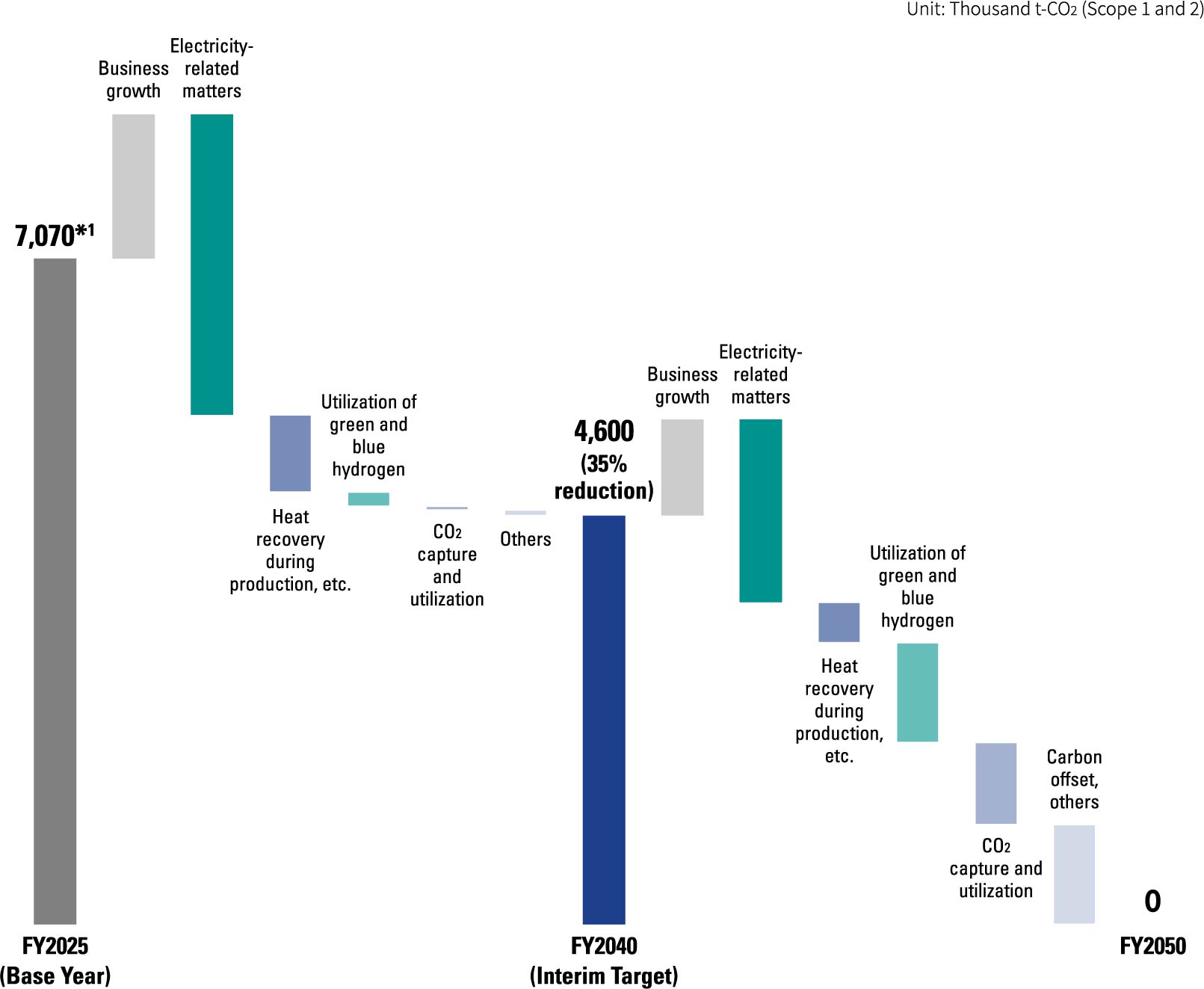
In 2023, the Shin-Etsu Group formulated and announced a plan to reduce greenhouse gas emissions (Scope 1 and 2) to net zero with the goal of achieving carbon neutrality by 2050. Meanwhile, as an interim target, we have continued to work to achieve the target set in 2016 to “Reduce greenhouse gas emissions in terms of production intensity to 45% (i.e. down 55%) of the FY1990 level by FY2025” by improving production efficiency in terms of production intensity to the greatest extent possible.
Since FY2025 is the final year of this interim target, we have set new interim targets as indicated below. Meanwhile, since approximately three years have passed since the announcement of our action plan for achieving carbon neutrality by 2050, we have revised it across the entire Group.
New interim targets
Taking 2025 as the base year,
- 1.Reduce greenhouse gas emissions in terms of production intensity by 30% by 2035
- 2.Reduce greenhouse gas emissions by 35% by 2040
Reasons for Setting Two Targets
Shin-Etsu Group has been working to reduce greenhouse gas emissions by improving its energy and raw material consumption in terms of production intensity, that is, by using energy and raw materials thoroughly and efficiently without waste. This policy will continue in the future as each of our businesses pursues the most efficient production in the industry. Since much of the reduction in terms of production intensity can be achieved through our own internal efforts, we have set the interim target to be reached by 2035.
On the other hand, reducing greenhouse gas emissions requires reducing emissions from electric power, switching fuels, and CO2 capture and utilization. These are measures that are difficult to implement through the efforts of individual companies alone, and can only be implemented through government leadership and collaborative efforts among the relevant industries. Since the development of the relevant infrastructure and policies requires time, we have set the interim target to be reached by 2040.
Initiatives Aimed at Carbon Neutrality
Our KPI is to increase both revenue and profit each fiscal year. To that end, each of our businesses has been working to expand sales by capturing growth in demand and augmenting production capacity to make that possible. In these investments to augment production capacity, it is our policy to always introduce the latest cutting-edge technology and to maximize productivity and energy efficiency to the utmost.
A prime example of this is Shintech, Inc. (USA), which continues to build and expand its polyvinyl chloride (PVC) resin manufacturing plants. Global demand for PVC resin has increased by approximately 20% over the past decade, and solid demand growth is expected in the future, mainly for housing and infrastructure. The final products made from PVC excel in insulation and durability, thus contributing to the reduction of greenhouse gas emissions themselves. However, looking at our currently available PVC production technologies from the perspectives of productivity, environmental impact, safety, and economic viability, it is possible to improve production efficiency in terms of production intensity, but it is not possible to reduce greenhouse gas emissions to zero.
By steadily capturing the ever-increasing global demand for PVC, Shintech has been able to expand its business and make numerous large-scale facility upgrades. Currently, PVC produced using outdated technologies like the carbide method accounts for 30% to 40% of the world's total. The outdated technology emits more than five times the amount of CO2 compared to Shintech's state-of-the-art technology. Shintech's ability to capture the ever-expanding demand for PVC with its state-of-the-art technology is helping to reduce global CO2 emissions.
Current Initiatives Aimed at Carbon Neutrality
A: In the process of implementation and expansion, B: Initial stage/partial implementation, C: Research and investigation stage
| Details of the initiative | Progress | |
|---|---|---|
| Reducing emissions from electric power | (1) Purchasing hydroelectric power | A |
| (2) Installation of solar power generation facilities | B | |
| (3) Purchasing low-carbon electric power | B | |
| (4) Transition of electric power companies to carbon neutral | Initiatives by governments and electric power companies | |
| Switching fuels | (5) Switching to natural gas fuel | A |
| (6) Utilization of carbon-neutral natural gas fuel | C | |
| (7) Utilization of green and blue hydrogen | C | |
| (8) Utilization of biomass fuel | B | |
| (9) Utilization of ammonia | C | |
| Continuous and thorough rationalization and efficiency improvement | (10) Productivity improvement (continuous operation) | A |
| (11) Improvement of reaction efficiency | A | |
| (12) Utilization of heat pumps | A | |
| (13) Heat recovery in raw material production | A | |
| (14) Installation of energy-efficient equipment | A | |
| (15) Increased use of charcoal reducing agents | A | |
| (16) Transition to new manufacturing processes | B | |
| CO2 capture and utilization | (17) Installation of CO2 capture equipment and utilization | C |
| Promotion of recycling | (18) PVC products | A |
| (19) Rare earth magnets | A | |
| (20) Other products | B | |
| Others | (21) Tree planting | A |
| (22) Carbon offset | C | |
| (23) Other new technologies | C | |
Roadmap toward Carbon Neutrality by 2050
The Group's reduction measures
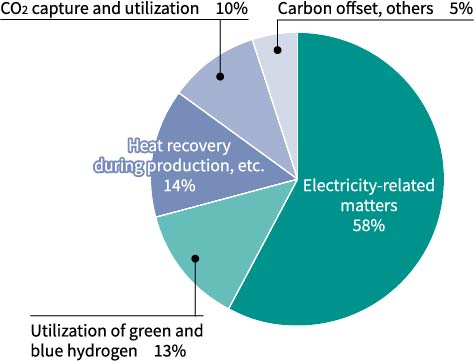
The components of reduction measures toward 2050 that the Company currently supposes are as described below. We will select the optimal ways to reduce emissions as technology evolves in the future.
Reducing greenhouse gas emissions by deploying renewable energy in Thailand
Three Shin-Etsu Group companies in Thailand—Shin-Etsu Silicones (Thailand), Ltd., Asia Silicones Monomer Ltd., and Shin-Etsu New Materials (Thailand) Ltd.—will receive renewable energy from a biomass cogeneration system from NS-OG Energy Solutions (Thailand) Ltd. (NSET), a joint venture between Nippon Steel Engineering Co., Ltd. and Osaka Gas Co., Ltd. The project is proceeding with the aim of starting energy delivery in 2027.
NSET’s renewable energy supply business is an initiative selected by the Ministry of the Environment’s “Financing Programme for Joint Crediting Mechanism (JCM) Model Projects”*1 in FY2024. NSET will install and manage the operation of the relevant facility at Shin-Etsu Silicones (Thailand), Ltd site and supply all the renewable energy (electricity and steam) produced using Thai wood chips as fuel to the three companies.
The new energy sourced through this initiative will cover a portion of the energy used by the three companies. This initiative is expected to reduce the combined greenhouse gas emissions of the three companies by approximately 48,000 t-CO2 per year.
*1Financing Programme for Joint Crediting Mechanism (JCM) Model Projects In that Programme, JCM model projects aim to reduce greenhouse gas emissions by utilizing leading decarbonization technologies in developing countries and other such regions while implementing Measurement, Reporting, and Verification (MRV) of these reductions. The goal is to help achieve greenhouse gas emission reduction targets in Japan and partner countries through the JCM while also reducing emissions in developing countries and other such regions. Model projects receive subsidies covering up to half of the initial investment costs for leading decarbonization technologies. The Programme is being implemented in collaboration with the Thai and Japanese governments.
Conceptual Framework of the Project Scheme

Participation in “Local production for local consumption type PPA (Gunma model)”
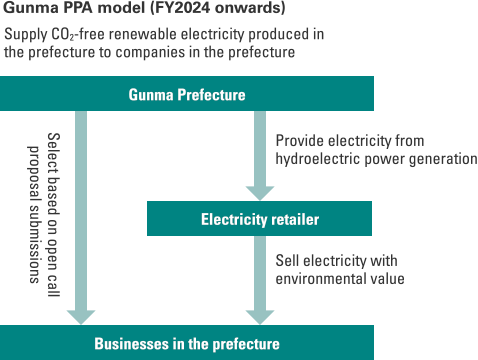
As an initiative to reduce emissions from electric power, in March 2024, Shin-Etsu Chemical decided to participate in the “Local production for local consumption type PPA”*2 (hereinafter, “Gunma Model”) offered by Gunma Prefecture.
The Gunma Model is a new system that supplies electricity from Gunma Prefecture's hydroelectric power plants to businesses in Gunma Prefecture. The electricity generated by hydroelectric power generation is green electricity that does not emit greenhouse gases. The new electricity procured through this program will cover all of the electricity used at the Yokonodaira Plant at Shin-Etsu Chemical's Gunma Complex, enabling the plant to reduce its greenhouse gas emissions by approximately 90%.
*2PPA
Abbreviation for "power purchase agreement." A type of contract in which an electricity user purchases electricity from a power producer at a fixed unit price for a fixed period of time.

Hydroelectric power plant in Gunma Prefecture
(Based on materials provided by Gunma Prefecture)
Installation of cogeneration systems
Shin-Etsu Chemical’s Gunma Complex and Naoetsu Plant have installed cogeneration systems*3 that use natural gas to produce steam and electricity to support the operation of their manufacturing facilities. In November 2022, the Gunma Complex added two gas turbine generators at the Isobe Plant and one at the Matsuida Plant in order to reduce greenhouse gas emissions.
These cogeneration systems were awarded the Chairman's Award in the Industrial Category, the highest award, at COGENERATION AWARD 2023 sponsored by the Advanced Cogeneration and Energy Utilization Center JAPAN. With the introduction of these cogeneration systems, the Isobe and Matsuida plants were able to achieve a self-sufficiency rate of 100% and reduce CO2 emissions by approximately 24,000 t-CO2 per year in the future.
*3Cogeneration system (heat and power combined)
This system generates power with engines, turbines, and fuel cells using natural gas, petroleum, liquefied petroleum gas, etc., and simultaneously collects the generated heat as steam. Effective use of both electricity and waste heat can reduce CO2 emissions and improve economic efficiency through energy conservation.

Other Initiatives to Help Realize a Carbon-neutral Society
Initiatives for Carrying Out Life Cycle Assessment
By conducting life cycle assessment, the Group will contribute to the reduction of greenhouse gases throughout the supply chain.
Reduction of Greenhouse Gas Emissions in Logistics
We are working to reduce greenhouse gas emissions during product transportation. This initiative will contribute to the reduction of scope 3 greenhouse gas emissions.
| Examples | Scope 3 emissions categories contributing to reductions |
|---|---|
| Modal shift*1 in methanol transport (switched from tank truck to railcar) |
Category 4: "Emissions from product transport" |
| Modal shift in silicon wafer transport (switched from aircraft to ocean vessel) |
|
| Modal shift in silicone products transport (switched from truck to railcar) |
*1Modal shift
Shifting from trucks and other freight transports to railways or ships with less environmental impact.
Expand Manufacturing and Sales of Products That Contribute to Reducing Greenhouse Gas Emissions
Our group's products are used in a wide range of fields, including housing, infrastructure, electric vehicles, DX and GX, and support the foundations of people’s lives and industries. Many of these products also help reduce greenhouse gases. In June 2021, The Japanese government has identified 14 essential areas to aim for carbon neutrality in 2050. The ratio of sales in these 14 areas to the Group's consolidated sales in FY2025 is approximately 70%. We will continue to contribute to the carbon neutrality of society as a whole by focusing on developing, manufacturing, and expanding sales of these products.
14 Growth Sectors

| 14 areas of expected growth*2 | Products and technologies listed in the Green Growth Strategy | Shin-Etsu Chemical Group products and technologies that contribute to green growth strategies*3 |
|---|---|---|
 (1)Offshore wind, solar and geothermal industries |
|
|
 (2)Hydrogen and fuel ammonia industry |
|
|
 (3)Next-generation heat energy industry |
|
|
 (4)Nuclear power industry |
|
|
  (5)Automotive and storage battery industry |
|
|
 (6)Semiconductor and information and communication industry |
|
|
 (7)Shipbuilding industry |
|
|
 (8)Logistics, people flow and civil engineering infrastructure industry |
|
|
  (9)Food industry, agriculture, forestry and fisheries |
|
|
 (10)Aircraft industry |
|
|
 (11)Carbon recycling and materials industry |
|
|
 (12)Housing, building industry, and next-generation electric power management industry |
|
|
 (13)Resource circulation industry |
|
|
 (14)Lifestyle-related industries |
|
|
*2Source: "Green Growth Strategy Through Achieving Carbon Neutrality in 2050"(announced by the Japanese government in June 2021)
*3Future products are included. The colors of the letters of products and technologies indicate business segments.
- Electronics Materials
- Infrastructure Materials
- Functional Materials
- Processing, Trading & Specialized Services
*4Semiconductor materials refer to silicon wafers, photoresists, mask blanks, pellicles, synthetic quartz glass substrates, substrates for gallium nitride epitaxial growth, high-purity silane, etc. Semiconductor materials fall under the semiconductor industry in field (6), but semiconductors manufactured using semiconductor materials contribute to control systems and other applications in a variety of fields, so they are also listed in fields other than (6).